 exuber
Multivariate / panel bubble tests
Test for Co-explosive Behaviour Between Two Series
cobubble_test
Replication record →
cobubble_test(
  y,
  x,
  lag = NULL,
  lag_grid = -6:6,
  nboot = 499L,
  sig_lvl = 95,
  seed = NULL
)
cobubble_test tests whether two series that each contain an explosive episode are co-explosive. That is, it tests whether the linear combination y_t - alpha - beta * x_{t-lag} is stationary, so that the explosive dynamics in y and x are the same underlying phenomenon, possibly migrating from one series to the other with a lead or lag, and not independent explosive episodes.
Arguments
| y, x | Numeric vectors of equal length, or objects that as.numeric()
can coerce to one. x is the candidate regressor with the explosive
episode, and y is tested for co-explosivity with x_{t-lag}. |
| lag | The lead or lag i in x_{t-lag}. If NULL
(default), it is estimated from lag_grid by minimizing the residual
variance (i_hat in Section VI). |
| lag_grid | Candidate lag values searched when lag = NULL. The default
-6:6 follows the simulation design of the paper. |
| nboot | Number of wild bootstrap replications. |
| sig_lvl | Significance level, on the same 0 to 100 scale as the
sig_lvl of datestamp (default 95, which gives a 5\%
upper-tail rejection region). |
| seed | Optional seed for the bootstrap draws. |
Value
An object of class cobubble_test_obj: a list with the observed statistic S, the (given or estimated) lag, the bootstrap critical value cv at sig_lvl, the bootstrap p-value p_value and reject, which is TRUE if S exceeds cv, that is, if co-explosivity is rejected.
Details
radf is a right-tailed ADF-family test for the presence of explosiveness. This function is a stationarity (KPSS-type) test instead. The null hypothesis is co-explosivity, that is, that the residuals of y regressed on a constant and x_{t-lag} are I(0). The null limiting distribution of the statistic depends on the pattern of heteroskedasticity in the errors (Evripidou, Harvey, Leybourne & Sollis 2022, Theorem 1). The critical values therefore come from a wild bootstrap that reproduces this pattern of heteroskedasticity in the bootstrap samples (Theorem 2).
Status
[Experimental]
Examples
These examples are copied from the package's own documentation and are run by R CMD check on every release.
The printed output (after #>) and the plots were produced by running them against the current package source.
# A co-explosive pair (the process of Evripidou et al.), which is not rejected
xy <- sim_coexplosive(n = 100, seed = 123)
res <- cobubble_test(xy$y, xy$x, nboot = 199L, seed = 1)
print(res)
#>
#> ── cobubble_test (lag = 0, nboot = 199) ────────────────────────────────────────
#>
#> S = 0.2364, cv(95%) = 0.4048, p-value = 0.1508
#> Co-explosivity not rejected at the 5% level.

# Force a specific lead or lag instead of estimating it
res_lag0 <- cobubble_test(xy$y, xy$x, lag = 0L, nboot = 199L, seed = 1)
print(res_lag0)
#>
#> ── cobubble_test (lag = 0, nboot = 199) ────────────────────────────────────────
#>
#> S = 0.2364, cv(95%) = 0.4048, p-value = 0.1508
#> Co-explosivity not rejected at the 5% level.

# Two independent bubbles: co-explosivity correctly rejected
cobubble_test(sim_data$psy1, sim_data$psy2, nboot = 199L, seed = 1)
#>
#> ── cobubble_test (lag = -2, nboot = 199) ───────────────────────────────────────
#>
#> S = 1.533, cv(95%) = 0.2998, p-value = 0
#> Co-explosivity rejected at the 5% level.

# Plot the two series that are tested for co-explosivity
autoplot(res)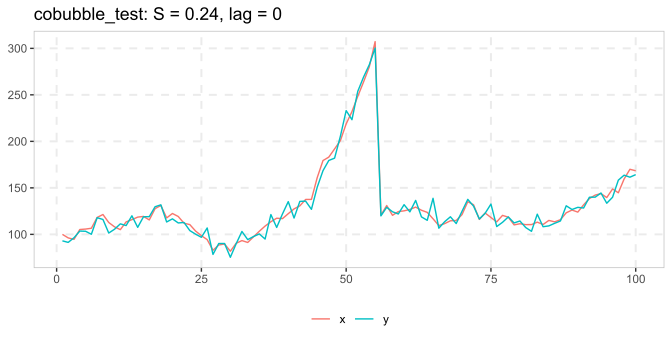
See also
Other multivariate: contagion_reg(), radf_common()
References
Evripidou, A. C., Harvey, D. I., Leybourne, S. J., & Sollis, R. (2022). Testing for co-explosive behaviour in financial time series. Oxford Bulletin of Economics and Statistics, 84(3), 624-650.