 exuber
Multivariate / panel bubble tests
Common-Bubble Detection via PCA + PSY
radf_common
Replication record →
radf_common(data, minw = NULL, r = 1)radf_common tests for a bubble that is common to a panel of series (Chen, Phillips & Shi, 2023). It extracts the first principal component of the panel and runs the ordinary radf test on it. The output is an ordinary radf_obj, so every downstream method (tidy(), autoplot(), datestamp() and so on) works on it without further effort.
Arguments
| data | A univariate or multivariate numeric time series object, a numeric
vector or matrix, or a data.frame. A column may have leading or trailing
NA values, which describes an unbalanced panel in which series enter or
exit the sample at different times. Those periods are filled with NA in
badf and bsadf and excluded from the adf, sadf and
gsadf of that series. Interior NA values (a gap in the middle of
a series) are not supported. When any series is padded in this way, the panel
statistics (bsadf_panel and gsadf_panel) are not available, and
the function returns NA for them with a warning. |
| minw | A positive integer. The minimum window size (default = , where T denotes the sample size). |
| r | Number of principal components to extract (default 1, which the paper
recommends as "sufficient... for the purpose of bubble identification"). Only the
first is used for detection. The others are returned for inspection in the
"prcomp" attribute. |
Value
A radf_obj (see radf) computed on the first principal component of the panel, with the fitted prcomp object attached as an attribute (attr(x, "prcomp")).
Details
Theorem 4.3 of the paper claims that the null limiting distribution of the resulting statistic is asymptotically identical to the standard PSY/GSADF distribution, which would let radf_mc_cv apply directly. An independent validation found that this identity does not hold at practical panel widths N. At N = 100 the true critical value is more than double that of radf_mc_cv, and the gap grows as N increases. PCA on a panel of independent (non-cointegrated) I(1) series does not behave like a single random walk once there are more series from which transient co-movement can arise. Use radf_common_cv for the critical values and not radf_mc_cv. The critical values of radf_mc_cv do not depend on the panel width, and they are badly undersized here once N grows past a handful of series.
Status
[Experimental]
Examples
These examples are copied from the package's own documentation and are run by R CMD check on every release.
The printed output (after #>) and the plots were produced by running them against the current package source.
# A panel of 5 series driven by one shared latent bubble factor
x <- sim_common(n_series = 5, n = 100, seed = 123)
res <- radf_common(x, minw = 20)
print(res)
#>
#> ── radf (minw = 20, lag = 0) ───────────────────────────────────────────────────
#>
#>        id     adf  sadf  gsadf
#>   series1  -2.577  5.78  5.922
#>
#>   gsadf_panel
#>         5.922

# radf_common_cv() is needed here and radf_mc_cv() does not apply (see Details)
cv <- radf_common_cv(n = 100, N = ncol(x), minw = 20)
summary(res, cv = cv)
#>
#> ── Summary (minw = 20, lag = 0) ────────────────── Monte Carlo (nboot = 1000) ──
#>
#> series1 :
#> # A tibble: 3 × 5
#>   stat  tstat  `90`  `95`  `99`
#>   <fct> <dbl> <dbl> <dbl> <dbl>
#> 1 adf   -2.58 0.333 0.676  1.32
#> 2 sadf   5.78 1.86  2.12   2.71
#> 3 gsadf  5.92 2.26  2.55   3.22

# The result is an ordinary radf_obj, so autoplot() and datestamp() work directly
autoplot(res, cv = cv)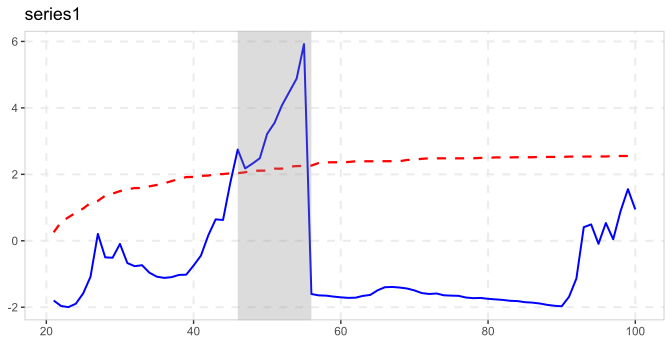
datestamp(res, cv = cv)
#>
#> ── Datestamp (min_duration = 0) ───────────────────────────────── Monte Carlo ──
#>
#> series1 :
#>   Start Peak End Duration   Signal Ongoing
#> 1    46   55  56       10 positive   FALSE
See also
radf for the underlying test, which is unmodified, and radf_common_cv for its critical values, which are specific to the panel width.
Other multivariate: cobubble_test(), contagion_reg()
References
Chen, Y., Phillips, P. C. B., & Shi, S. (2023). Common Bubble Detection in Large Dimensional Financial Systems. Journal of Financial Econometrics, 21(4), 989-1063.