 exuber
Real-time monitoring
Sequential LBI Monitoring for an Unknown Bubble Start Date (Breitung & Diegel 2025)
monitor_lbi
Replication record →
monitor_lbi(data, r_star = 0.5, c_bar = 0, sig_lvl = 95)monitor_lbi implements the sequential, constant-boundary extension of the locally best invariant statistic of lbi_test. It monitors a series in real time when the start date of the bubble is unknown. After a training window [1, T*] that is assumed free of exuberance, it compares the (optionally exponentially weighted) partial sum of the post-training first differences with a constant boundary and flags the first monitoring date at which the boundary is breached.
Arguments
| data | A univariate or multivariate numeric time series object, a numeric
vector or matrix, or a data.frame. A column may have leading or trailing
NA values, which describes an unbalanced panel in which series enter or
exit the sample at different times. Those periods are filled with NA in
badf and bsadf and excluded from the adf, sadf and
gsadf of that series. Interior NA values (a gap in the middle of
a series) are not supported. When any series is padded in this way, the panel
statistics (bsadf_panel and gsadf_panel) are not available, and
the function returns NA for them with a warning. |
| r_star | The end of the training window: a fraction in (0, 1) of the
sample (default 0.5), or an integer number of observations if
>= 1. |
| c_bar | Exponential up-weighting parameter for later monitoring
observations, which are more likely to be bubble-like (their eq. 12), >= 0.
The default 0 is the flat-weight "mCUSUM" variant, which is appropriate
when a bubble is equally likely to start at any point in the monitoring window.
For a moderate gain in power when a bubble that starts partway through the
window is more plausible, the paper suggests 2. The critical values
(sig_lvl) are the same for every c_bar. |
| sig_lvl | Significance level on the 0 to 100 scale used throughout the
package, one of 90, 95, 97.5, 99 or 99.5.
Table 1 of Breitung & Diegel tabulates only these. |
Value
An object of class monitor_lbi_obj: a list with the statistic path in the monitoring region (stat), the constant boundary, the length of the training window T_star, and alarm and alarm_date (the first breach, NA if there is none).
Details
Their eq. 15 shows that this partial sum, normalized by the fixed length of the monitoring horizon, converges to a standard Brownian motion on [0, 1] under the null. The normalization is not sqrt(t), which differs from the Chu-Stinchcombe-White-style boundary of monitor_cusum. A single constant boundary therefore controls size uniformly across the whole monitoring window. The paper shows that this constant-boundary detector ("mCUSUM" at c_bar = 0, "wCUSUM" at c_bar > 0) is more powerful than the classical CUSUM test with a time-varying boundary, to which it is compared.
Status
[Experimental]
Examples
These examples are copied from the package's own documentation and are run by R CMD check on every release.
The printed output (after #>) and the plots were produced by running them against the current package source.
# A martingale training window, explosive from t = 150 to the sample end
y <- sim_psy1(n = 200, te = 150, tf = 200, seed = 7)
res <- monitor_lbi(y, r_star = 100)
print(res) # alarm should fire soon after t = 150
#>
#> ── monitor_lbi (T* = 100 / 200, c_bar = 0, b_alpha = 1.95) ─────────────────────
#>
#>    series  alarm  alarm_date
#>   series1    155         155
autoplot(res)
#> Warning: Removed 1 row containing missing values or values outside the scale range
#> (`geom_segment()`).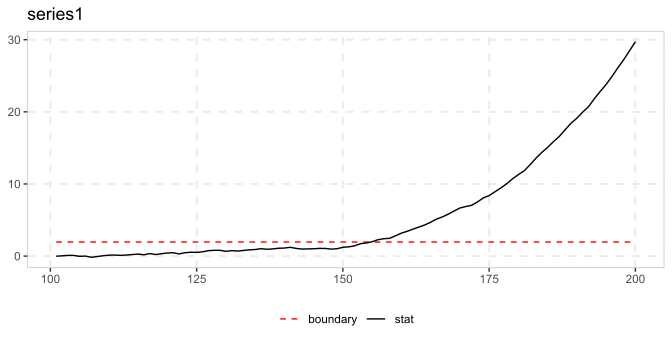
# wCUSUM: exponentially up-weight later monitoring observations
autoplot(monitor_lbi(y, r_star = 100, c_bar = 2))
#> Warning: Removed 1 row containing missing values or values outside the scale range
#> (`geom_segment()`).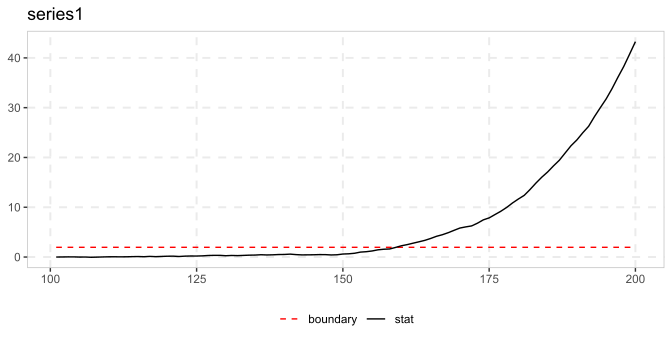
See also
lbi_test for the static version, which assumes a known bubble window that spans the full sample. monitor_cusum and monitor are monitoring detectors with a structurally different construction.
Other monitoring: monitor(), monitor_cusum(), monitor_quantile()
References
Breitung, J., & Diegel, M. (2025). A locally best invariant sequential test for explosive behavior in the presence of nonstationary volatility. Journal of Time Series Analysis.