 exuber
Volatility-robust (other routes)
Recursively Demeaned Sign-Based Bubble Test (s-bar-PWY / s-bar-PSY)
radf_sign_dm
Replication record →
radf_sign_dm(data, minw = NULL)radf_sign_dm computes the second sign-based analogue of the recursive right-tailed unit root test of Harvey, Leybourne & Zu (2020), which the paper denotes /. The construction is the same as in radf_sign, but it is built on a recursively (expanding-window) demeaned cumulated-sign series, Ctilde_t = sum_{i=2}^{t}
(sign(diff(y)_i) - mean(sign(diff(y)_{2:i}))), and not on the raw cumulated sign that radf_sign uses.
Arguments
| data | A univariate or multivariate numeric time series object, a numeric
vector or matrix, or a data.frame. A column may have leading or trailing
NA values, which describes an unbalanced panel in which series enter or
exit the sample at different times. Those periods are filled with NA in
badf and bsadf and excluded from the adf, sadf and
gsadf of that series. Interior NA values (a gap in the middle of
a series) are not supported. When any series is padded in this way, the panel
statistics (bsadf_panel and gsadf_panel) are not available, and
the function returns NA for them with a warning. |
| minw | A positive integer. The minimum window size (default = , where T denotes the sample size). |
Value
An object of class radf_sign_dm_obj/radf_obj. It is the same adf/badf/sadf/bsadf/gsadf list as for radf, and it pairs with radf_sign_dm_cv.
Details
Harvey, Leybourne, Tatlow & Zu (2025) show that this statistic shares the asymptotic level-shift robustness of radf_sign (see the Level-shift robustness section of that function). It does not need Assumption 2 of the underlying HLZ (2020) theory, that the median of the innovations is zero, which is a strictly weaker requirement than the one radf_sign needs for its own invariance result. Their finite-sample simulations also find that the recursive demeaning tends to reduce the size distortion under level shifts further than radf_sign does, although both are asymptotically robust to level shifts under the same condition.
Status
[Experimental]
Examples
These examples are copied from the package's own documentation and are run by R CMD check on every release.
The printed output (after #>) and the plots were produced by running them against the current package source.
# Volatility triples half-way through the sample. This is the case of
# non-stationary volatility that this test is built for, and plain radf()
# over-rejects here
y <- sim_psy1(n = 200, seed = 1, e = sim_vol_break(199))
res <- radf_sign_dm(y, minw = 20)
print(res)
#>
#> ── radf_sign_dm (minw = 20) ────────────────────────────────────────────────────
#>
#>    series       adf   sadf  gsadf
#>   series1  -0.03298  2.492  6.081

cv <- radf_sign_dm_cv(n = 200, minw = 20)
summary(res, cv = cv)
#>
#> ── Summary (minw = 20, lag = 0) ───── Sign-Based MC (demeaned) (nboot = 2000) ──
#>
#> series1 :
#> # A tibble: 3 × 5
#>   stat    tstat  `90`  `95`  `99`
#>   <fct>   <dbl> <dbl> <dbl> <dbl>
#> 1 adf   -0.0330 0.853  1.28  2.09
#> 2 sadf   2.49   2.45   2.80  3.46
#> 3 gsadf  6.08   3.32   3.66  4.58
tidy(res, cv = cv)
#> # A tibble: 1 × 4
#>   id          adf  sadf gsadf
#>   <fct>     <dbl> <dbl> <dbl>
#> 1 series1 -0.0330  2.49  6.08
datestamp(res, cv = cv)
#>
#> ── Datestamp (min_duration = 0) ──────────────────── Sign-Based MC (demeaned) ──
#>
#> series1 :
#>   Start Peak End Duration   Signal Ongoing
#> 1    91  103 115       24 positive   FALSE
#> 2   156  157 158        2 negative   FALSE
#> 3   159  160 161        2 negative   FALSE
autoplot(res, cv = cv)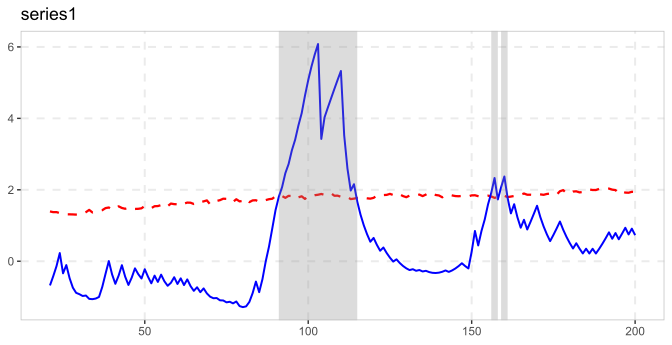
See also
radf_sign_dm_cv for critical values, and radf_sign for the non-demeaned sign-based analogue.
Other volatility-robust tests: cusum_test(), radf_kp(), radf_sbz(), radf_sbz_union(), radf_sign(), radf_tt(), ssu_test()
References
Harvey, D. I., Leybourne, S. J., & Zu, Y. (2020). Sign-based unit root tests for explosive financial bubbles in the presence of deterministically time-varying volatility. Econometric Theory, 36(1), 122-169.
Harvey, D. I., Leybourne, S. J., Tatlow, D., & Zu, Y. (2025). Unit root tests for explosive financial bubbles in the presence of deterministic level shifts. Oxford Bulletin of Economics and Statistics, 87(5), 879-901. 10.1111/obes.12668