 exuber
Volatility-robust (other routes)
Stochastic Unit Root Bubble Test (Kurozumi & Nishi 2025)
ssu_test
Replication record →
ssu_test(
  data,
  minw = NULL,
  sig_lvl = 95,
  type = c("ssu", "gssu"),
  union = FALSE,
  cv = NULL
)
ssu_test implements the SSU and GSSU statistics of Kurozumi & Nishi (2025). They are sup-type tests for a bubble that test for a stochastic, and not deterministic, unit root in the squared first differences, (Delta y_t)^2 = mu2 + omega*y_{t-1}^2 + eta_t. The statistic is bias-corrected for the dependence on the correlation between the innovations of this regression and those of the plain ADF regression.
Arguments
| data | A univariate or multivariate numeric time series object, a numeric
vector or matrix, or a data.frame. A column may have leading or trailing
NA values, which describes an unbalanced panel in which series enter or
exit the sample at different times. Those periods are filled with NA in
badf and bsadf and excluded from the adf, sadf and
gsadf of that series. Interior NA values (a gap in the middle of
a series) are not supported. When any series is padded in this way, the panel
statistics (bsadf_panel and gsadf_panel) are not available, and
the function returns NA for them with a warning. |
| minw | Minimum window. The default is psy_minw for
"ssu" and the value of the paper, floor(n * (-0.004 + 2.24/sqrt(n))),
for "gssu". Table I is computed at these values. |
| sig_lvl | Significance level on the 0 to 100 scale used throughout the
package, one of 90, 95 or 99. Table I of Kurozumi & Nishi
tabulates these levels. |
| type | "ssu" or "gssu". |
| union | Logical. Also run the union-of-rejections procedure with SADF
("ssu") or GSADF ("gssu"). |
| cv | Critical values for the SADF or GSADF side of the union, for example from
radf_mc_cv with lag = 0. The default is the precomputed
critical values, which are fetched on first use. |
Value
An object of class ssu_test_obj: a list with the statistic path (stat, one value for each candidate end point from minw to n. For GSSU it is the sup over window starts at each end point), the constant crit from Table I, sadf (the maximum, which is compared with crit) and detected. With union = TRUE the list also contains adf_stat (SADF or GSADF), union_stat, union_crit and union_detected.
Details
This test generalizes the framework differently from the other volatility-robustness tests in exuber. It does not touch the innovation variance at all. It allows the explosive AR coefficient itself to vary stochastically over time, 1 + c1/T + a*u_t/sqrt(T), where every recursive-ADF-family statistic in this package assumes the deterministic coefficient 1 + c/T^alpha.
type = "ssu" is the single recursion, with the start fixed at the beginning of the sample, which has the shape of SADF. type = "gssu" also takes the supremum over window starts, which has the shape of GSADF, with the minimum window r0 = -0.004 + 2.24/sqrt(n) from the paper. The paper finds that GSSU is no more powerful than SSU.
union = TRUE adds the union-of-rejections procedure that the paper recommends: UR = max(SADF / cv_sadf, SSU / cv_ssu) (or GUR with GSADF and GSSU), compared with the published scaling constant ur (gur). Neither SADF nor SSU dominates. SSU wins when the explosive coefficient is stochastic, SADF wins when it is deterministic, and the union stays close to the better of the two. The SADF or GSADF side is radf with its default minimum window and lag = 0, compared with cv (default: the precomputed critical values).
Status
[Experimental]
Examples
These examples are copied from the package's own documentation and are run by R CMD check on every release.
The printed output (after #>) and the plots were produced by running them against the current package source.
# A stochastically varying explosive root, rho_t = 1 + 3/n + 4 * u_t / sqrt(n).
# This is the alternative that ssu_test() is built for, and lbi_test() is built
# for a fixed root
y <- sim_psy1(n = 150, te = 75, tf = 150, c = 3, alpha = 1, seed = 2001,
  coef_noise = rnorm(149), coef_a = 4)
res <- ssu_test(y, sig_lvl = 95)
print(res)
#>
#> ── ssu_test (SSU, n = 150, minw = 23, sig_lvl = 95%, crit = 3.3) ───────────────
#>
#>    series   sadf  detected
#>   series1  15.02      TRUE

# The double-recursion version
ssu_test(y, type = "gssu")
#>
#> ── ssu_test (GSSU, n = 150, minw = 26, sig_lvl = 95%, crit = 5.37) ─────────────
#>
#>    series   sadf  detected
#>   series1  15.02      TRUE

# Plot the recursive SSU statistic path against its critical value
autoplot(res)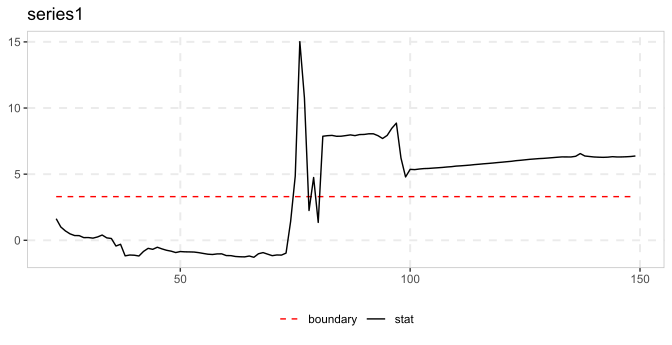
See also
radf for the recursive ADF-family alternative with a deterministic coefficient, which this test complements.
Other volatility-robust tests: cusum_test(), radf_kp(), radf_sbz(), radf_sbz_union(), radf_sign(), radf_sign_dm(), radf_tt()
References
Kurozumi, E., & Nishi, M. (2025). Bubble testing with stochastically varying explosive coefficient. Journal of Time Series Analysis, 46(5), 945-965.