 exuber
Volatility-robust (other routes)
Kernel-Purged Heteroskedasticity-Robust PSY Test
radf_kp
Replication record →
radf_kp(data, minw = NULL, kernel = c("gaussian", "uniform"), h = NULL)radf_kp implements the heteroskedasticity-robust PSY test of Harvey, Leybourne, Taylor & Zu (2024), which needs no bootstrap. It "purges" unconditional heteroskedasticity by dividing each first difference of the series by a kernel spot-volatility estimate (eq. 4-5) and cumulating the result. It then runs the ordinary radf, with an intercept, on the purged series.
Arguments
| data | A univariate or multivariate numeric time series object, a numeric
vector or matrix, or a data.frame. A column may have leading or trailing
NA values, which describes an unbalanced panel in which series enter or
exit the sample at different times. Those periods are filled with NA in
badf and bsadf and excluded from the adf, sadf and
gsadf of that series. Interior NA values (a gap in the middle of
a series) are not supported. When any series is padded in this way, the panel
statistics (bsadf_panel and gsadf_panel) are not available, and
the function returns NA for them with a warning. |
| minw | A positive integer. The minimum window size (default = , where T denotes the sample size). |
| kernel | Kernel for the spot-volatility estimator, "gaussian"
(default, as in the paper) or "uniform". |
| h | Bandwidth for the spot-volatility estimator. The default is
0.1 * T^(-0.25), the setting of the paper (Table I, Section 6). |
Value
A radf_obj with the same structure as the output of radf, computed on the volatility-purged series, so radf_mc_cv, tidy() and the other methods apply directly.
Details
The paper proves (Theorem 1 and Remark 3.2) that the null limiting distribution of the purged statistic is identical to the standard homoskedastic GSADF null. radf_mc_cv, the existing and already fast Monte Carlo critical values of exuber, therefore apply directly to the result. Unlike radf_wb_cv and radf_sbz_cv, no new bootstrap or simulation code is needed.
Only the with-intercept variant ( in the paper) is implemented. The paper also proposes a variant without an intercept and a union-of-rejections test that combines both. They are not implemented here (see the package's enhancement notes for the cost and benefit considerations).
Status
[Experimental]
Examples
These examples are copied from the package's own documentation and are run by R CMD check on every release.
The printed output (after #>) and the plots were produced by running them against the current package source.
# Volatility triples half-way through the sample. This is the case of
# non-stationary volatility that this test is built for, and plain radf()
# over-rejects here
y <- sim_psy1(n = 200, seed = 1, e = sim_vol_break(199))
res <- radf_kp(y, minw = 20)
print(res)
#>
#> ── radf (minw = 20, lag = 0) ───────────────────────────────────────────────────
#>
#>        id     adf   sadf  gsadf
#>   series1  -1.715  1.503  2.633
#>
#>   gsadf_panel
#>         2.633

# radf_mc_cv() applies unmodified (see Details)
cv <- radf_mc_cv(n = attr(res, "n"), minw = 20)
summary(res, cv = cv)
#>
#> ── Summary (minw = 20, lag = 0) ────────────────── Monte Carlo (nboot = 1000) ──
#>
#> series1 :
#> # A tibble: 3 × 5
#>   stat  tstat   `90`    `95`  `99`
#>   <fct> <dbl>  <dbl>   <dbl> <dbl>
#> 1 adf   -1.72 -0.328 0.00172 0.572
#> 2 sadf   1.50  1.19  1.48    1.97
#> 3 gsadf  2.63  1.99  2.27    2.87
autoplot(res, cv = cv)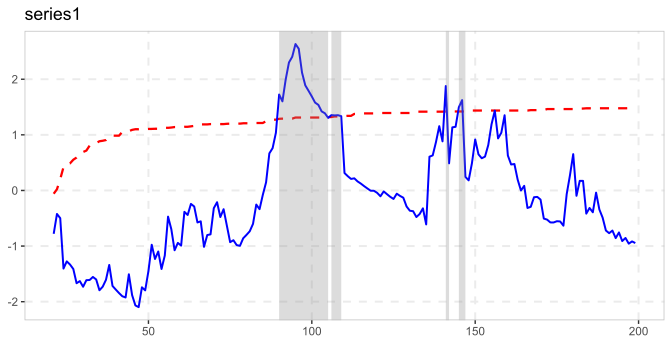
See also
radf_mc_cv for the critical values of this test, which are unmodified, radf_wb_cv for a bootstrap-based alternative, and radf_tt for another alternative that needs no bootstrap.
Other volatility-robust tests: cusum_test(), radf_sbz(), radf_sbz_union(), radf_sign(), radf_sign_dm(), radf_tt(), ssu_test()
References
Harvey, D. I., Leybourne, S. J., Taylor, A. M. R., & Zu, Y. (2024). A new heteroskedasticity-robust test for explosive bubbles. Journal of Time Series Analysis. 10.1111/jtsa.12784