 exuber
Dating procedures
Bias-Corrected Bubble Dating (Kejriwal, Nguyen & Perron 2025)
dating_knp
Replication record →
dating_knp(data, trim = 0.05, omit = TRUE, breaks = 2L)dating_knp dates bubble episodes (origination and collapse) by minimizing a sum of squared residuals that is corrected by omitting a residual. The model has alternating regimes: a unit root, an explosive regime, and a unit root that resumes from a shifted level after an instantaneous collapse, and so on. Plain OLS over this model is provably inconsistent, because the estimate of the origination date converges to the true collapse date and not to the origination date. The default omit = TRUE fixes this by dropping the squared residual at each candidate collapse date from the objective before minimizing.
Arguments
| data | A univariate or multivariate numeric time series object, a numeric
vector or matrix, or a data.frame. A column may have leading or trailing
NA values, which describes an unbalanced panel in which series enter or
exit the sample at different times. Those periods are filled with NA in
badf and bsadf and excluded from the adf, sadf and
gsadf of that series. Interior NA values (a gap in the middle of
a series) are not supported. When any series is padded in this way, the panel
statistics (bsadf_panel and gsadf_panel) are not available, and
the function returns NA for them with a warning. |
| trim | Minimum fraction of the (differenced) sample required in each regime (default 0.05). |
| omit | Use the consistency-restoring correction of Kejriwal, Nguyen & Perron
(default TRUE). FALSE gives the plain OLS estimator, which is
provably inconsistent (their Theorem 1). It is kept mainly to demonstrate the
effect of the correction and not for practical dating. |
| breaks | Number of break dates (the paper's m), two for each bubble.
An odd number lets the last bubble run to the end of the sample, and its collapse
is then NA. |
Value
An object of class dating_knp_obj: a list with origination and collapse (dates) and delta (the fitted explosive AR coefficient). For a single bubble these are named vectors with one value for each series, and for more bubbles they are matrices with one row for each bubble and one column for each series.
Details
breaks = 2 (the default) is the single-bubble model. More breaks use the dynamic-programming algorithm of Kejriwal, Nguyen & Perron, which returns the exact global minimizer of the objective in O(breaks * n^2). As in the paper, the number of breaks is taken as given, for example two for each episode that datestamp finds.
Status
[Experimental]
Examples
These examples are copied from the package's own documentation and are run by R CMD check on every release.
The printed output (after #>) and the plots were produced by running them against the current package source.
res <- dating_knp(sim_data$psy1, trim = 0.05)
print(res)
#>
#> ── dating_knp (n = 100, trim = 0.05, omit = TRUE, breaks = 2 ───────────────────
#>
#>    series  bubble  origination  collapse  delta
#>   series1       1           41        55  0.964
autoplot(res)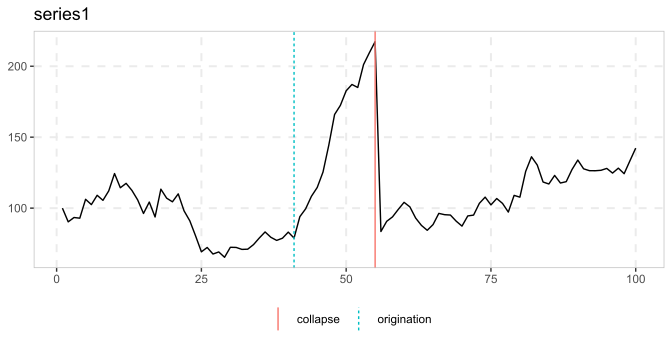
# Compare the bias-corrected estimate with the plain (inconsistent) OLS one,
# adding an extra reference line to the output of autoplot()
res_plain <- dating_knp(sim_data$psy1, trim = 0.05, omit = FALSE)
autoplot(res) +
  ggplot2::geom_vline(xintercept = as.numeric(res_plain$origination), linetype = 3)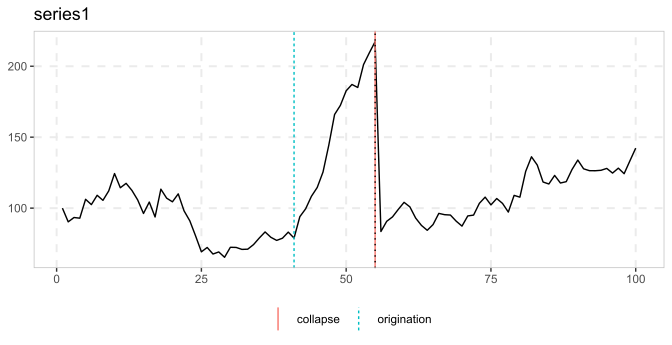
# Two bubbles
dating_knp(sim_data$psy2, breaks = 4)
#>
#> ── dating_knp (n = 100, trim = 0.05, omit = TRUE, breaks = 4 ───────────────────
#>
#>    series  bubble  origination  collapse  delta
#>   series1       1           18        40  1.074
#>   series1       2           59        70  1.066
See also
dating_hls and dating_pdc for related SSR-based dating approaches.
Other dating: dating_hls(), dating_hlw(), dating_pdc(), radf_recovery(), rootstamp()
References
Kejriwal, M., Nguyen, L., & Perron, P. (2025). An improved procedure for retrospectively dating the emergence and collapse of bubbles. Journal of Time Series Analysis, 46(5), 867-883.