 exuber
Dating procedures
Multi-Bubble SSR/BIC Dating (Harvey, Leybourne & Whitehouse 2020)
dating_hlw
Replication record →
dating_hlw(
  data,
  cv = NULL,
  minw = NULL,
  trim = 0.1,
  min_duration = NULL,
  nboot = 199L,
  seed = NULL,
  join = 3L
)
dating_hlw extends dating_hls to series with more than one explosive episode. It first runs the existing detection and dating of PSY (radf and datestamp) to locate a preliminary start and end for each episode. It then splits the sample into disjoint date windows around them and dates each window again with the SSR/BIC fitting of dating_hls, restricted to Models 2 and 4 for every window except the last.
Arguments
| data | A univariate or multivariate numeric time series object, a numeric
vector or matrix, or a data.frame. A column may have leading or trailing
NA values, which describes an unbalanced panel in which series enter or
exit the sample at different times. Those periods are filled with NA in
badf and bsadf and excluded from the adf, sadf and
gsadf of that series. Interior NA values (a gap in the middle of
a series) are not supported. When any series is padded in this way, the panel
statistics (bsadf_panel and gsadf_panel) are not available, and
the function returns NA for them with a warning. |
| cv | Critical values for the step-1 PSY detection and dating, as accepted by
datestamp. The default NULL computes radf_wb_cv
internally. |
| minw | Minimum window size for the step-1 radf call. The
default is psy_minw. |
| trim | Minimum fraction of the (differenced) sample required in every regime (default 0.05, following the choice of Harvey, Leybourne & Sollis in their empirical application. Their simulations use 0.1). |
| min_duration | Minimum duration (in observations) for a step-1 PSY episode
to be counted. The default is psy_ds (the rule of
HLW). |
| nboot, seed | Passed to radf_wb_cv when cv is not
supplied. |
| join | The run-joining rule of HLW for fragmented step-1 detections. Two
explosive runs that are separated by at most join non-rejections and are
each at least long are treated as one episode. The default is 3, the
value in the paper, and 0 disables joining. |
Value
An object of class dating_hlw_obj: a list with one element for each series. Each element is a data frame with one row for each detected episode (model, origination, collapse, recovery). A series with no step-1 detected episode gets a data frame with zero rows.
Details
When exactly one episode is detected, the function reduces to dating_hls applied to the whole series, which is a stated property of the paper. The single window then runs over [1, n] and fits all four models.
Status
[Experimental]
Examples
These examples are copied from the package's own documentation and are run by R CMD check on every release.
The printed output (after #>) and the plots were produced by running them against the current package source.
res <- dating_hlw(sim_data$psy1, trim = 0.1, nboot = 199L, seed = 1)
print(res)
#>
#> ── dating_hlw (n = 100, trim = 0.1) ────────────────────────────────────────────
#>
#> series1:
#>  model origination collapse recovery
#>      4          41       55       71

# Plot the breakpoints of every detected episode over the series
autoplot(res)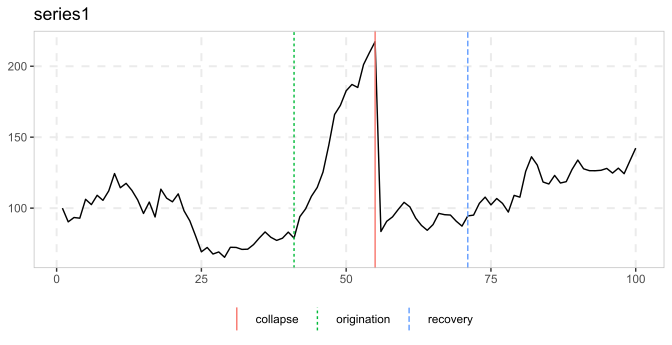
# A two-bubble series, for which dating_hls() alone would fit only one bubble
res2 <- dating_hlw(sim_psy2(n = 200, seed = 123), trim = 0.1, nboot = 199L, seed = 1)
autoplot(res2)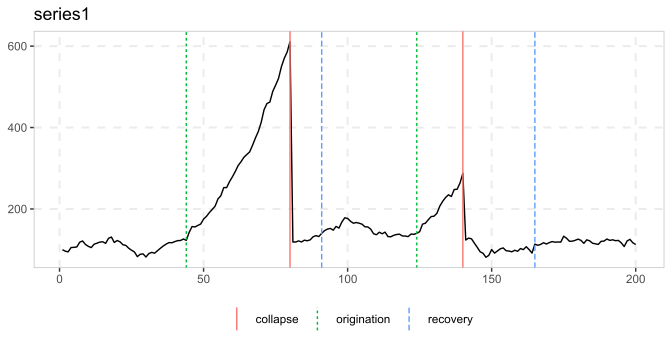
See also
dating_hls for the single-bubble fitting that this function wraps, and datestamp for the multi-bubble threshold-crossing dating of PSY.
Other dating: dating_hls(), dating_knp(), dating_pdc(), radf_recovery(), rootstamp()
References
Harvey, D. I., Leybourne, S. J., & Whitehouse, E. J. (2020). Date-stamping multiple bubble regimes. Journal of Empirical Finance, 58, 226-246.