 exuber
Simulation
Simulation of a two-bubble process
sim_psy2 sim_psy2(
n,
te1 = 0.2 * n,
tf1 = 0.2 * n + te1,
te2 = 0.6 * n,
tf2 = 0.1 * n + te2,
c = 1,
alpha = 0.6,
sigma = 6.79,
seed = NULL
)This data generating process is similar to sim_psy1, with the difference that there are two episodes of mildly explosive dynamics.
Arguments
| n | A positive integer specifying the length of the simulated output series. |
| te1 | A scalar in (0, n) specifying the observation in which the first bubble originates. |
| tf1 | A scalar in (te1, n) specifying the observation in which the first bubble collapses. |
| te2 | A scalar in (tf1, n) specifying the observation in which the second bubble originates. |
| tf2 | A scalar in (te2, n) specifying the observation in which the second bubble collapses. |
| c | A positive scalar determining the autoregressive coefficient in the explosive regime. |
| alpha | A positive scalar in (0, 1) determining the value of the expansion rate in the autoregressive coefficient. |
| sigma | A positive scalar indicating the standard deviation of the innovations. |
| seed | An object specifying if and how the random number generator (rng)
should be initialized. It is either NULL or an integer, which is passed to
set.seed before the simulation. If you set it, the value is saved as the
"seed" attribute of the returned value. The default, NULL, leaves the state of
the rng unchanged and returns .Random.seed as the "seed" attribute. Results are
reproducible across the parallel and the non-parallel option when you use the
same seed. |
Value
A numeric vector of length n.
Details
The two-bubble data generating process is given by (see also sim_psy1):
where the autoregressive coefficient is:
with , , , , , , , , where is the last observation of the sample. The observations and are the origination and termination dates of the first bubble; and are the origination and termination dates of the second bubble. After the collapse of the first bubble, resumes a martingale path until time , and a second episode of exuberance begins at . Exuberance lasts until , at which point the process collapses to a value of . The process then continues on a martingale path until the end of the sample period . The duration of the first bubble is assumed to be longer than that of the second bubble, i.e. .
For further details you can refer to Phillips et al., (2015) p. 1055.
Examples
These examples are copied from the package's own documentation and are run by R CMD check on every release.
The printed output (after #>) and the plots were produced by running them against the current package source.
# 100 periods with bubble origination dates 20/60 and termination dates 40/70
sim_psy2(n = 100, seed = 123) %>%
 autoplot()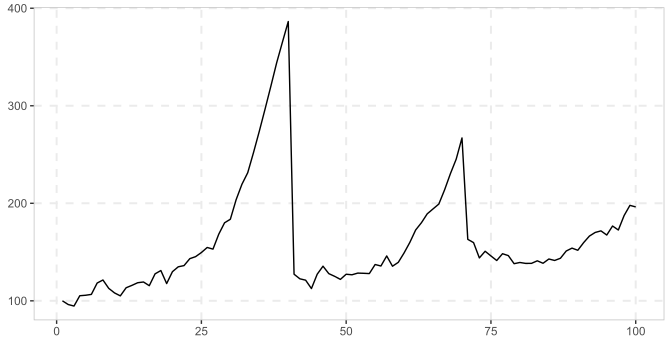
# 200 periods with bubble origination dates 40/120 and termination dates 80/140
sim_psy2(n = 200, seed = 123) %>%
  autoplot()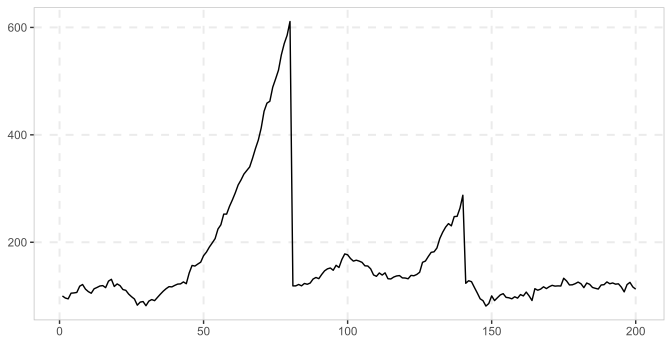
See also
References
Phillips, P. C. B., Shi, S., & Yu, J. (2015). Testing for Multiple Bubbles: Historical Episodes of Exuberance and Collapse in the S&P 500. International Economic Review, 5 6(4), 1043-1078. 10.1111/iere.12132